Overview
 Around National Hazing Prevention Week, or anytime, a case study competition is a great way to engage students in your community in thoughtful discussion and dialogue about how to deal with important issues impacting your campus, community, and fraternal organizations. The Case Study experience creates a space for you to look at an issue or problem from a perspective that is likely different from your own. By “walking in someone else’s shoes,” you create an opportunity to expand your own horizon and perspectives, developing a new and different way to understand an issue or experience.
Order of Omega has been supporting case study experiences for over three decades at national and regional conferences as an experiential learning tool to enhance the conference attendee experience. This experience can translate to a good program for campus communities or national organizations. For questions, comments, or to discuss in more detail, please reach out to Order of Omega headquarters hq@orderofomega.org.
Program Overview: An experiential learning competition where teams analyze a fraternity/sorority scenario and present solutions to a panel of judges
Time Commitment: 2-3 hours total event time (includes preparation time, presentation, and awards)
Team Size: Teams of 2 participants from different chapters
Basic Structure: Teams receive case study → Preparation time → 15-minute presentation → 5-minute Q&A → Judging and awards
Ideal For: Campus-wide FSL programming, leadership development, council collaborations, or conference sessions
Staffing Needs: 1 Coordinator + 3 judges per track (6-8 teams per track recommended)
The competition allows participants to further strengthen skills such as creative problem solving, public speaking, collaboration, and strategic planning. Teams of two sign up for an opportunity to develop the most comprehensive plan to present to a panel of judges.
Overall, this is an educational learning experience, not merely a contest.
Its goals are to:
- Develop leadership decision-making and ethical reasoning
- Provide applied learning for fraternity/sorority members
- Foster professional dialogue between students and judges
- Create networking and mentoring opportunities
- Reinforce Order of Omega’s mission of leadership, collaboration, and service
All participants, judges, and coordinators are expected to maintain a positive, professional, and supportive learning environment. It is not required to have an Order of Omega chapter involvement or participation, but it is highly encouraged if applicable or available.
Learning Outcome 1: Critical thinking skill
- Develop critical and reflective thinking abilities
- Appreciate creative expression and aesthetics
- Demonstrate the ability to use theories
- Develop an appreciation and sensitivity to human differences
- Exhibit knowledge and awareness of diversity around identities, cultures, and society
Learning Outcome 2: Teamwork
- Demonstrate an understanding of groups dynamics
- Understand how to practice effective teamwork
- Demonstrate how to express your ideas and opinions effectively respectfully and confidently
Learning Outcome 3: Communicate
- Effectively communicate ideas to community, professional, and global
- Ability to communicate about the root causes of issues related to community needs
- Develop awareness of current human and community needs
These standards apply to all campus-based competitions and should be shared clearly with participants and judges.
Ethics
- The competition aligns with professional ethical standards used in student affairs and higher education.
- Participants and judges are expected to act with integrity, fairness, and respect throughout the process.
Confidentiality
- Participants may only discuss the case with their assigned partner/team.
- Case materials may not be shared with others until the competition concludes.
- Judges may discuss the case only with other judges.
- Absolute confidentiality must be maintained until the winners are announced.
Professionalism Expectations Judges
- Treat participants as developing professionals
- Provide constructive, educational feedback
- Evaluate ideas impartially
- Recognize creativity and thoughtful risk-taking
Participants
- Maintain a positive attitude
- Be realistic and thoughtful in recommendations
- Engage respectfully with judges
- Treat the experience as applied learning, not performance theater
Each competition should designate a case study competition coordinator. This is typically a chapter advisor, campus professional, Order of Omega representative or chapter officer.
Coordinator
The Coordinator oversees logistical and scheduling, ensures policies are followed, and serves as a final decision maker on procedural issues or disqualifications
Judges
- Suggested three (3) judges per track
- Judges rank teams but do not disqualify participants
- Judges should receive materials in advance, including the scoring rubric and timeline
- Judges should be FSL advising staff, student affairs staff, community standards, faculty or others experienced in working with students. This is a good opportunity to work with other areas on campus to help promote the positive values of fraternity and sorority life
- Student Leaders, council officers, or Order of Omega members could be good options for judges but should likely only be a seat on a panel of judges.
Scheduling
- If more than 6-8 teams it is recommended scheduling is formatted where there are Tracks of Teams. Those teams compete against each other in that Track for first, second and third.
- An example schedule would look as follows:
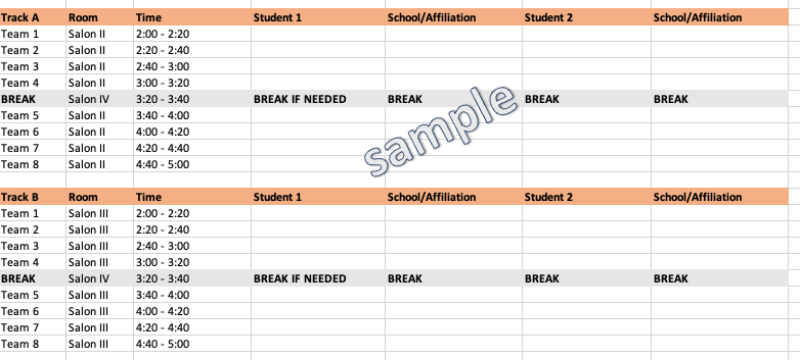
This sample timeline is based on a 2.5-hour event with 8 teams (organized into two tracks of 4 teams each). Adjust timing based on the number of teams and available space. This timeline is based on
Within 24 hours of start time: Case Study scenario is provided to participant teams
30 minutes before: Judges arrive and receive orientation (case study, rubric, timeline, expectations)
Start time: Participant check-in and orientation session. Teams receive case study scenario and are directed to preparation spaces
+3 hours: Teams present during time blocks (15 min presentation + 5 min Q&A per team)
All presentations conclude; judges deliberate and select 1st, 2nd, 3rd per track
Awards ceremony and closing remarks (could be part of a larger program/banquet)
Note: If you have more than 8 teams, add additional tracks or extend the timeline. Each additional team adds approximately 20 minutes to the presentation block.
- It is recommended to create a case study scenario that can be relevant to all councils and experiences. This might involve multiple issues of phrasing things in a context that allows for participants to identify with the scenario in some way.
- While a primary purpose of the case study is to think about things from others perspectives, it is still important for the case study scenario to be one that can be transferable to the participants experience.
- Order of Omega is providing sample case study scenarios below, but working with campus professionals in the fraternity and sorority life office can be a best practice to develop the scenario used. It is recommended the scenario change for each case study competition event.
Sample Scenarios: Large Public IFC, Small Private PHC, Regional Commuter Fraternity, Regional Commuter NALFO, Medium Public NPHC
Chapters may adapt formats, but the recommended structure is as follows:
- Teams of two participants
- Student/student tracks
- Teams made up of participants from different chapters
- Assign presentation time slots and rooms
- Teams are given 15 minutes to present with 5 min Q&A
- Identify Alternate or standby teams
- Rules should be communicated clearly and early
- No formal presentations or technology used as visual aids for the presentation
- Notes are permitted for personal use
- No handouts or visual aids are permitted
- Books, websites, and other material may be referenced or used as resources
- Participants may NOT consult with advisors or others
- Participants should use AI responsibly and not use it to complete their presentation; however, it might be used as a way to develop ideas.
- This is not a research paper. It is an applied decision-making and critical thinking exercise.
- Participants should be guided and provided with an outline of what the presentation will look like, explaining some of the following
- Participants will check in somewhere and be directed to a room with judges for a presentation
- Participants will introduce themselves (as themselves, participants are not role-playing)
- Judges introduce themselves
- Judges with state “Please Begin.”
- Participants will have 15 minutes to present, with judges giving advance warning as time expires
- Participants conclude with “This concludes our presentation.”
- Judges provide 5 minutes of Q&A or oral feedback
- Participants are excused
- Judges will evaluate teams holistically using criteria such as…
- Articulation and verbal communication
- Logic and organization ideas
- Interpretation of policies and best practices
- Understanding of legal concerns and liabilities
- Use of campus and community resources
- Awareness of media and reputational considerations
- Feasibility of solutions and strategies
- Team collaboration and shared leadership
- Ultimately judges will need to select a 1st, 2nd, and 3rd for each track
- Hazing Prevention Network can provide downloadable participation certificates and LinkedIn credential via Certifier (a list of participants names and email addresses will need to be provided to HPN)
- Offering an award or recognition could be valuable to encourage participation and involvement in the experience
- 1st, 2nd, 3rd place recognition per track
- Certificates or plaques could be a good option for winners
- A modest monetary award could also make a difference. This could be in the form of a gift card, cash, or special items, for example. $200 for 1st place teams, $150 for 2nd place teams, $100 for 3rd place teams (these amounts would be split between the participants)
- Public recognition at a banquet or closing program can be valuable and is important
Coordinators should offer a brief orientation session or document prior to the competition. This might occur simultaneously with signing up to participate or after teams have signed up to participate and before receiving a copy of their case study
- Expect an Experiential learning environment
- Supportive, constructive judge interaction
- Emphasis on decision making not always a “right answer.”
- Have fun and engage fully
- Make reasonable assumptions
- Reference what you know
- Be honest about limitations
- Focus on the process, values, and leadership judgment
- Have fun
- A strong case study competition involves a follow-up or evaluation process
- Ask participants and judges for feedback on how to improve the experience
- Conduct a debrief of the planning process
- Keep documentation for the future
For questions or assistance, please contact Order of Omega headquarters at hq@orderofomega.org or call 817-265-4074